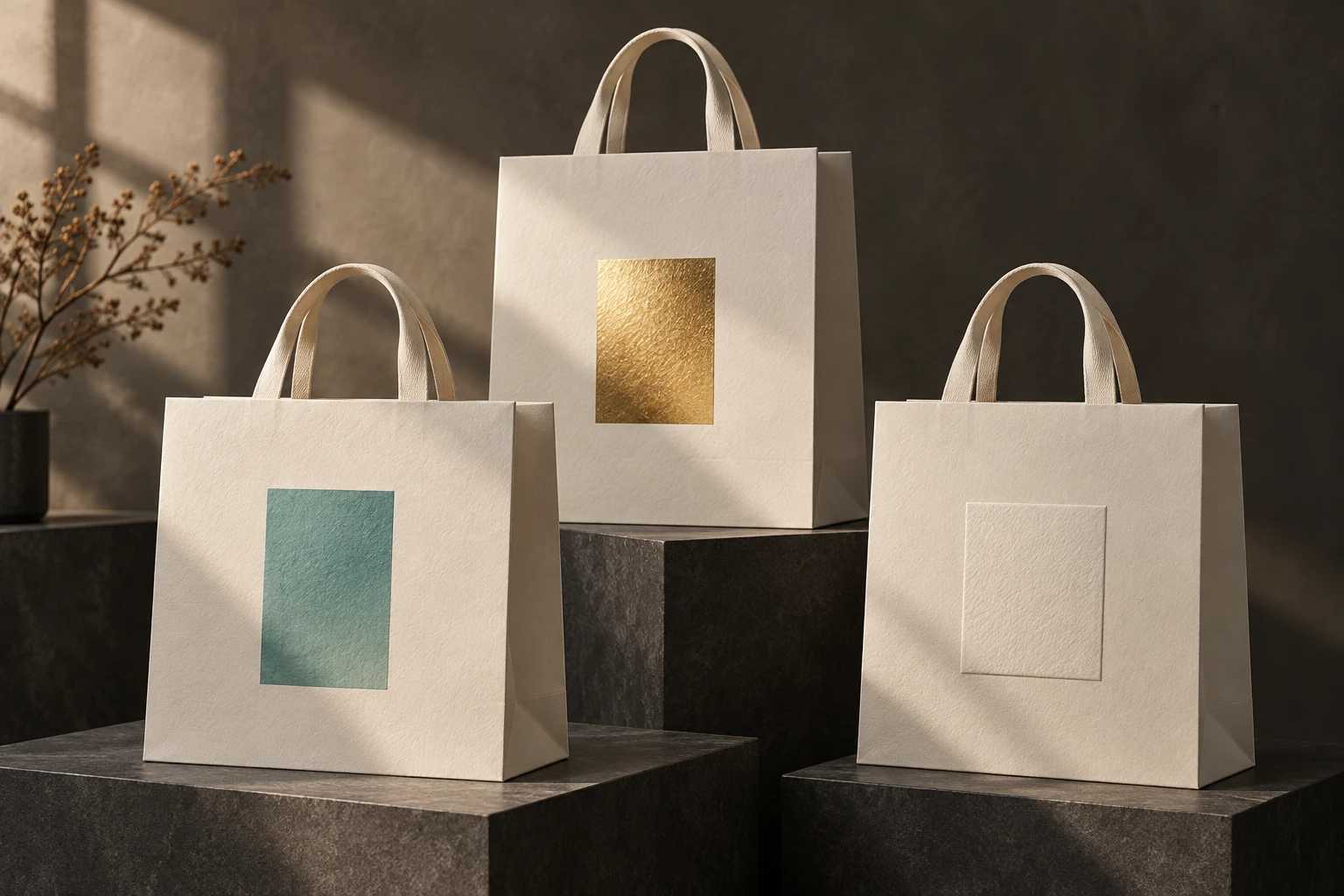
Post-printing processing greatly determines the visual and tactile feel of the paper bag. To choose the right one, businesses should determine what they want the recipient to pay attention to: the entire surface, a metallic logo or an embossed detail on the paper background.
There is no one technique that works for all brands. Results also depend on paper, design, finishing materials and processing conditions.
Matt lamination: creates a less reflective surface
Matte lamination is often chosen for conservative designs or when a surface is desired to look subdued in light. It may cause the color perception to be different from the unlaminated print, so it is necessary to approve the sample after the correct finish.
Do not assume that matte lamination will prevent scratches well in all cases. With a dark background, rubbing marks or fingerprints may be noticeable depending on the type of film. If you need to limit scratches, you must exchange specific materials and try packaging and use.
Glossy lamination: take advantage of reflection
Gloss lamination creates a more reflective surface, which is often considered when an image or color is desired to have a bright feel. In a multi-light point of sale, reflections can also affect the visibility of details.
Take a look at the sample from the front and side angles. If the design has small text, check readability in real-life lighting, rather than just choosing based on a sample photo.
Needle pressing: for targeted pressing areas
Laminating uses heat and pressure to transfer the decorative layer from the laminated film, often called foil, to the paper. The needle color is not limited to gold or silver, but the actual choice should be confirmed according to available materials.
This technique should be viewed at the correct design scale. Strokes that are too small, large pressure patches, or grainy paper surfaces can all affect the results. You should not take a general line size threshold for all cases without discussing it with the processing place.
Embossing and debossing: creating shapes on the surface
Embossing creates raised details, while debossing creates concave areas. Effects can be used alone or combined with printing and foiling if configured properly. Paper, mold and design placement all need to be considered.
Details should avoid affecting the glued area, folds or strap attachment points. A beautifully embossed flat paper sample needs to continue to be evaluated once the bag has been created.
Choose according to design goals
| Target | Technicians should see samples | Points to check |
|---|---|---|
| The surface looks soft | Matt lamination or suitable coating | Color after finishing, rubbing marks |
| Clear reflective surface | Ball rolling | Point of sale lighting, readability |
| Press logo or pattern | Needle pressing | Clarity, position, grip |
| Creates a feeling of touch | Embossed or debossed | Image clarity, affects structure |
With a set of cosmetic packaging with a light background, a small laminated logo can be the main highlight, while the text is kept simple. For a store with a youthful design, a clear array of colors and a suitable finish may be enough, it is not necessary to add many effects.
Including costs and post-use processing capabilities
Molds, materials and additional steps can affect price as well as schedule. Ask what costs are incurred the first time and the conditions for reusing the mold in the next order.
If plastic lamination is used, the bag will have additional ingredients other than paper. Therefore, you should not write “100% paper” or infer the recyclability of the finished product. Treatment needs to consider the actual structure and collection system at the place of use.
Browse on suitable templates
It is recommended to confirm the paper, printing color and effect together to get an overall look. A well-defined and stable accent is often more useful than many uncoordinated techniques.
Send SquareBag your design or reference image along with the desired surface feel. We will discuss processing options with you and need to see samples before finalizing.