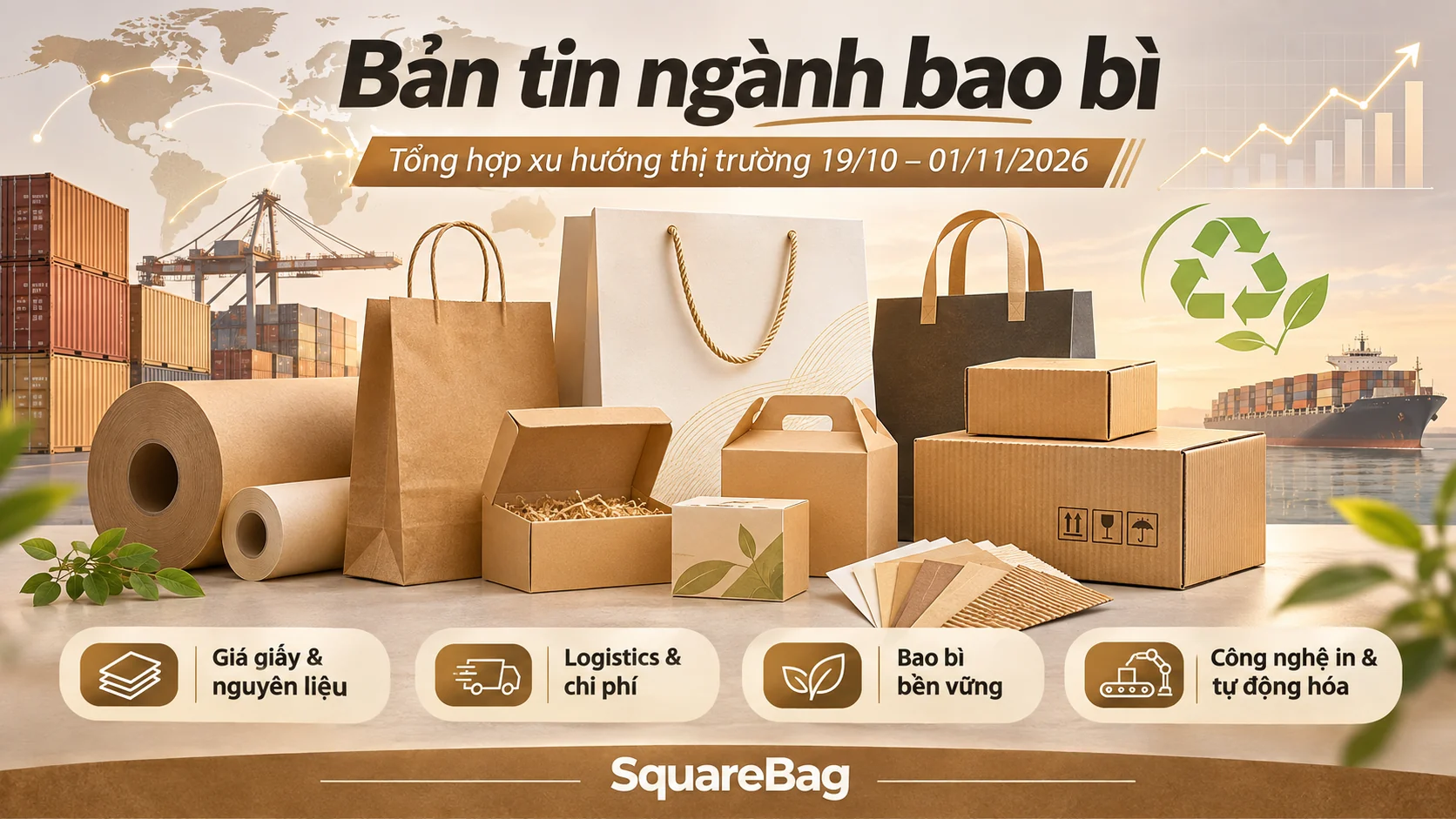
The global packaging industry entered the final weeks of October 2026 amid several significant developments. Rising recycled paper and production costs continued to put pressure on manufacturers, while ocean freight rates on major international trade routes showed signs of recovery.
At the same time, the European Union (EU) moved forward with proposed adjustments to Extended Producer Responsibility (EPR) requirements. Meanwhile, PACK EXPO International 2026 highlighted advances in paper-based packaging materials, automation and artificial intelligence (AI).
SquareBag reviews the key developments from October 19 to November 1, 2026, and examines their potential implications for paper bag, paper box and packaging manufacturers in Vietnam.
1. Asia–Europe and Trans-Pacific Ocean Freight Rates Rebound
After a period of adjustment, container freight rates on several major international shipping routes began recovering in the second half of October.
According to the Freightos Baltic Index (FBX), benchmark rates for 40-foot containers on four key routes were as follows:
| Shipping Route | Oct. 20, 2026 | Oct. 28, 2026 |
|---|---|---|
| Asia – Northern Europe | USD 3,442 | USD 3,551 |
| Asia – Mediterranean | USD 3,927 | USD 4,252 |
| Asia – US West Coast | USD 8,126 | USD 8,368 |
| Asia – US East Coast | USD 9,700 | USD 10,565 |
In its October 28 update, Freightos reported weekly increases of 3%, 8%, 3% and 9%, respectively, across these routes.
The increases came as shipping lines adjusted capacity, some Asian ports continued to experience congestion, and adverse weather affected vessel schedules.
According to Alphaliner data cited by Freightos, nearly two-thirds of Asia–Europe container shipping capacity had returned to routes through the Red Sea and Suez Canal. Shorter routes may reduce transit times, although regional security conditions remain a source of uncertainty.
Implications for Vietnam's Packaging Industry
- Exporters of paper bags and paper boxes should monitor freight movements when preparing FOB, CIF or DDP quotations.
- Orders with longer delivery schedules may require adjustments to freight surcharge clauses.
- Procurement teams should update their estimates for shipping lead times and potential delays in imported materials.
Although freight rates increased on several international routes, these figures are general market benchmarks rather than direct quotations for shipments originating in Vietnam. The developments observed in late October are also insufficient to confirm the beginning of a sustained upward freight cycle.
2. Recycled Paper Prices and Production Costs Remain Under Pressure
Sonoco's third-quarter 2026 financial results, released on October 21, together with the subsequent earnings call, highlighted the impact of cost inflation on the paper packaging industry.
According to the company's disclosures:
- Old Corrugated Containers (OCC) costs were approximately 90% higher year over year.
- Uncoated Recycled Paperboard (URB) production costs increased by more than USD 60 per ton compared with the same period a year earlier.
- Industrial packaging revenue increased by 5.2%, while consumer packaging revenue declined by 2.9% compared with Q3 2025.
These figures reflect Sonoco's operating conditions and cost structure, rather than market-wide changes in global paper prices.
On October 28, Smurfit Westrock also released its third-quarter results, reporting approximately USD 8.16 billion in revenue. The company indicated that inflation in energy, transportation and raw material costs had exceeded expectations, while continuing to implement pricing adjustments and productivity improvements.
Implications for Vietnamese Manufacturers
Changes in recovered paper costs in major markets may indirectly influence prices for industrial paper, recycled paperboard and other packaging inputs.
For paper bag and paper box manufacturers, effective material management should focus on three areas: actual purchasing costs, material waste rates and paper utilization efficiency.
When input costs are difficult to forecast, optimizing sheet layouts, material consumption standards and converting processes can create meaningful competitive advantages.
3. EU Proposes Simplified EPR Obligations for Certain Packaging Producers
On October 21, 2026, the Council of the European Union adopted its negotiating position on a proposal to simplify certain administrative obligations under the Packaging and Packaging Waste Regulation (PPWR).
Under the proposal, companies established in the EU could be exempted from appointing an authorized representative in another member state if they place less than one tonne of packaging on that country's market annually.
The proposal aims to reduce administrative burdens on smaller businesses. However, it is not yet final legislation and does not constitute a general exemption from EPR responsibilities or an automatic exemption for Vietnamese exporters to the EU.
The PPWR began applying in stages from August 12, 2026, with the objective of reducing packaging waste, improving recyclability and advancing the circular economy.
Opportunities for Vietnam's Paper Packaging Industry
Packaging suppliers serving EU customers should pay closer attention to:
- The practical recyclability of packaging materials and structures.
- Material sourcing, composition and technical documentation.
- Designs that minimize unnecessary material consumption.
- Compliance with customer-specific and destination-market requirements.
For paper bags and paper boxes, material-efficient designs, simplified multilayer structures and appropriate coating technologies may open opportunities for product innovation.
4. PACK EXPO 2026: Paper Packaging, Robotics and AI Take Center Stage
PACK EXPO International 2026 took place in Chicago, United States, from October 18 to 21, bringing together more than 2,700 exhibitors and over 43,000 attendees, according to organizer PMMI.
Technologies presented at the exhibition highlighted three major trends: replacing plastics where suitable, reducing material consumption and expanding industrial automation.
Paper-Based Alternatives to Selected Plastic Packaging Applications
Graphic Packaging International showcased Boardio, a paperboard-based packaging solution designed to replace certain conventional container formats, alongside EnviroClip, which uses paperboard to group cans and bottles in multipack applications.
According to information presented at the event, Boardio can reduce plastic use by approximately 90% compared with the packaging formats it replaces in the showcased applications.
Paper E-Commerce Packaging Automation
The Rennco 301 Paper E-Commerce system uses heat-sealable paper instead of plastic film for selected packaging applications.
The machine can adjust bag dimensions to match products, integrate shipping-label printing and connect with warehouse management systems.
This represents an important development for e-commerce packaging, where reduced material consumption and automated packing processes are becoming increasingly relevant.
AI and Robotics in Packaging Production
CAMA Group presented integrated cartoning systems and AI-powered operational monitoring technologies.
Meanwhile, Maneva's vision inspection platform focuses on identifying the underlying causes of defects rather than simply classifying products as pass or fail.
These developments illustrate the industry's transition from automating individual operations toward data-driven production line management.
SquareBag's Perspective
For printing and paper packaging converters, digital solutions can be implemented progressively, beginning with quotation management, material consumption standards and production planning, before expanding into automated quality control.
Manufacturers do not necessarily need to invest in fully automated production lines immediately. Standardized operational data and production processes are essential foundations for scaling AI adoption.
5. Global Packaging Demand Remains Uneven Across Markets
Financial reports released in late October suggest that the recovery in packaging demand remains inconsistent across market segments and regions.
Sonoco reported growth in industrial packaging revenue but a decline in its consumer packaging business. Nevertheless, international paper can volume increased at a double-digit rate.
Smurfit Westrock reported improvements in its North American converting businesses. However, cost pressures and uneven regional growth continued to affect overall performance.
International Paper also emphasized challenges related to fuel, energy and recovered paper costs in its October 28 report, while continuing to restructure its operations.
These developments point to two simultaneous trends: stronger cost-control requirements and emerging growth opportunities in packaging segments aligned with evolving demand.
For Vietnamese manufacturers, fashion paper bags, retail shopping bags, gift boxes, e-commerce boxes and corrugated packaging may continue to offer opportunities. However, competitiveness will depend heavily on product quality, cost efficiency, delivery performance and manufacturing flexibility.
6. Three Key Packaging Industry Developments to Watch in November 2026
First: Paper prices and raw material costs. Manufacturers should monitor kraft paper, duplex board, ivory board, corrugated board and recovered paper prices, particularly the extent to which cost inflation in major markets affects Asian supply chains.
Second: International freight volatility. Freight adjustments, shipping capacity and security conditions along the Red Sea route may influence delivery planning and export costs.
Third: Environmental regulations and technology investment. Further developments in PPWR/EPR requirements, together with paper-based materials, digital printing, AI-enabled quality inspection and automation, will continue shaping the packaging industry.
7. Outlook: Cost Optimization and Sustainability Must Advance Together
Developments from October 19 to November 1, 2026, demonstrate that the packaging industry faces multiple pressures, including cost inflation, trade volatility, environmental requirements and rapid technological change.
For Vietnamese paper packaging manufacturers, adaptability involves more than adjusting selling prices. It also requires stronger capabilities in product design, material selection and production efficiency.
SquareBag believes that combining product quality, efficient material utilization, manufacturing technology and environmental responsibility will remain fundamental to building a sustainable competitive advantage.
As market conditions continue to evolve, manufacturers that proactively invest in operational management and customer-oriented packaging solutions will be better positioned to capture future growth opportunities.
This article has been compiled, edited and analyzed by SquareBag using publicly available international sources. Assessments of potential implications for Vietnam are provided for general market reference and do not constitute price forecasts or commercial quotations.
References
- Freightos — October 20, 2026 update (published October 21)
- Freightos / AJOT — October 28, 2026 update
- Sonoco — Third Quarter 2026 Results
- Smurfit Westrock — Third Quarter 2026 Results
- Council of the EU — EPR negotiating position, October 21, 2026
- PMMI — PACK EXPO International 2026 recap
- PKN Packaging News — Paper, robots and smart closures
- International Paper — Third Quarter 2026 Results
- Packaging Dive — Sonoco OCC and URB costs, earnings-call reporting