A paper carrier can suit heavy goods when its complete construction meets the intended conditions. The purchasing decision is therefore about which specification has been checked with which product set. A clear load-check record gives retail teams a practical basis for acceptance and helps prevent unsuitable bags reaching customers.
1. Define the goods and carrying journey
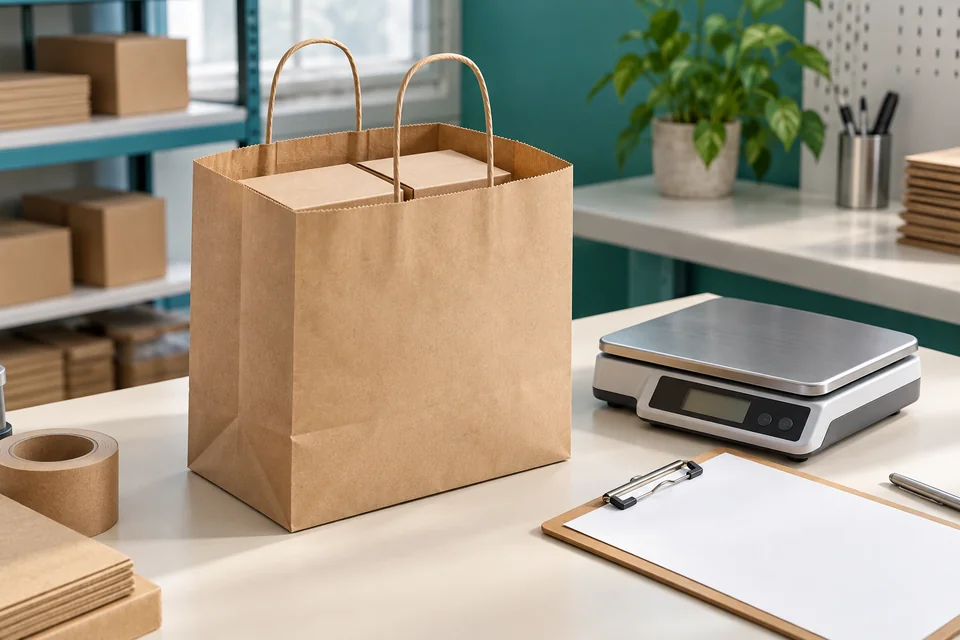
Weigh the complete order, including product boxes, accessories and protective material. Select both a typical order and the heaviest order within the intended use. Record dimensions, placement and any uneven load. Equal weights can put different pressure on the base and handle attachments.
Describe lifting from the counter, walking, setting the bag down and lifting again. Sharp corners and fragile bottles need suitable protection: a bag's carrying performance does not establish that its contents are protected.
2. Agree the check before reviewing samples
Agree sample quantity, load, holding time, lifting cycles, grip and environmental conditions with the manufacturer. Define acceptance criteria in advance. If a standards-based assessment is needed, discuss EN 13590 for retail carrier bags with a testing laboratory.
An in-store handling check must not be described as EN 13590 compliance. This article outlines internal preparation rather than universal loads, safety factors or cycle counts; those parameters require agreement for the exact specification and purpose.
3. Inspect during and after handling
Watch the base seams, side seam, folds and handle attachment areas. Record early damage such as partial adhesive release, stretched handle holes, a sagging base or tears against box edges. An intact handle alone does not make a sample acceptable if products tilt or deform.
Photograph the same locations before and after the check and link results to sample codes. Separate bag defects from packing errors and uneven loading. Change one group of variables at a time to identify whether paper, adhesive, handles or reinforcement resolves the issue.
4. Include moisture and actual handling
Dry indoor conditions may differ from the customer's journey. Describe humidity, light rain or condensation from cold goods when selecting materials and checks. Kraft colour and dry rigidity do not establish water resistance.
Repeat the relevant checks after changing paper, adhesive, handle supplier, dimensions or conversion methods. Results for one bag do not automatically transfer to a larger size, a different handle or an unevenly loaded order.
5. Keep a batch acceptance record
Record specification and revision, sample details, product set, conditions, criteria, photographs and sign-off. Retain an approved sample for comparison with production. At delivery, inspect conformity and sample according to the agreed plan.
Grammage in g/m² describes paper mass per area, not a bag's carrying capacity in kilograms. Publish a load claim only when supported by results for the finished construction and the confirmed conditions.
6. Know when to change the packing approach
For orders beyond the checked range, split the goods or choose a more suitable carrying and protective structure. Adding paper without identifying the failure point can miss the problem. Aim for dependable customer handling and repeatable store packing.
Share a sample product set, the current bag specification and the handling scenario with SquareBag. These inputs help both parties agree the sample and acceptance checks before production is decided.
Technical references
Discuss your specification with SquareBag
Explore this topic