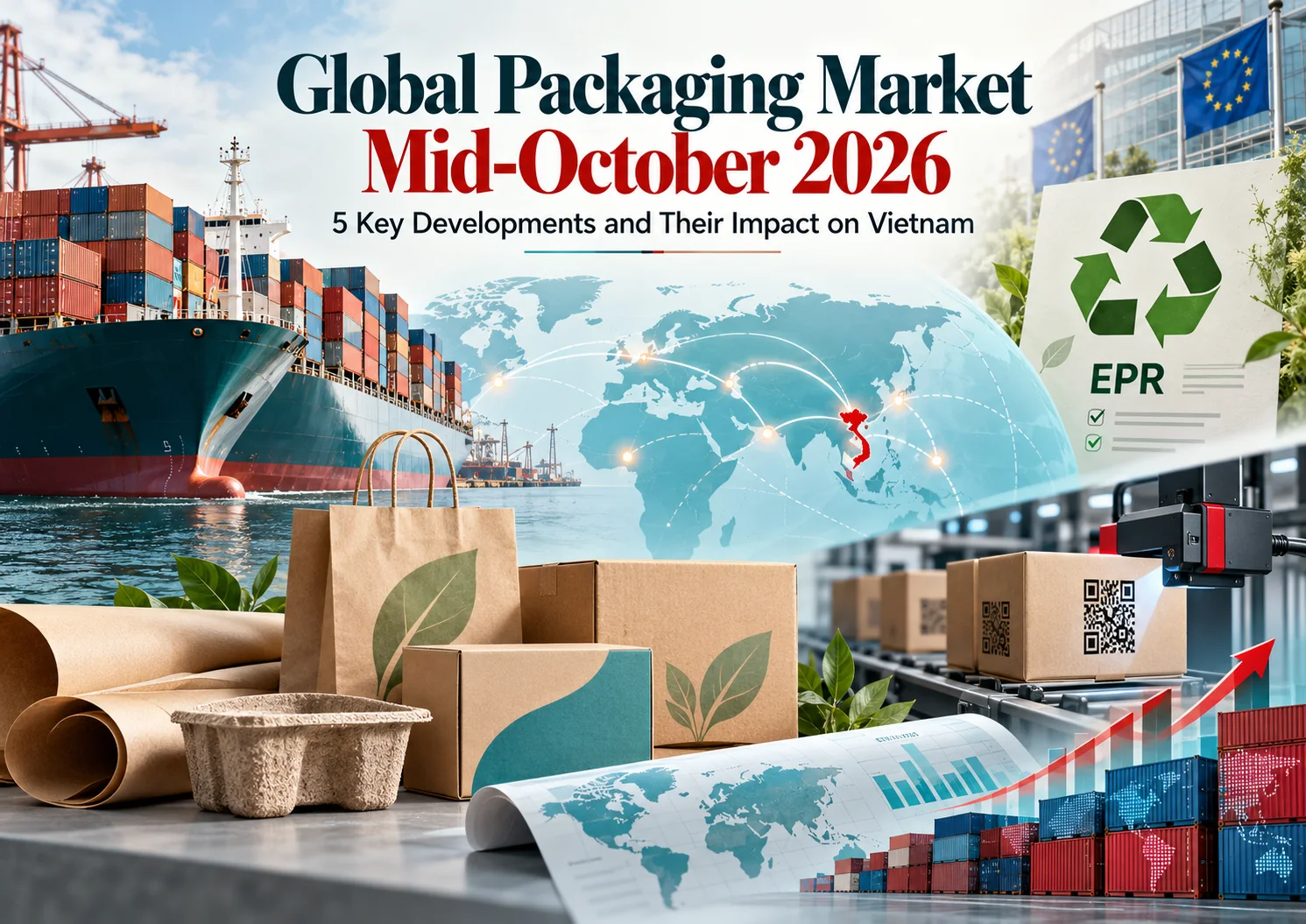
The global packaging industry is navigating uneven freight costs, evolving environmental regulations, emerging materials, advances in printing technology, and corporate restructuring. For Vietnamese packaging manufacturers, these developments present both operational challenges and opportunities to strengthen their position in international supply chains.
Five notable developments reported between October 12 and 15, 2026, illustrate how competitiveness in packaging increasingly depends on more than production costs alone.
1. Asia–Mediterranean Freight Rates Rise 7% as Logistics Volatility Persists
According to Freightos' October 14 report, spot container shipping rates from Asia to the Mediterranean increased by 7% during the previous week, reaching approximately USD 3,800 per forty-foot equivalent unit (FEU).
Meanwhile, Asia–Northern Europe rates remained relatively stable, while Asia–US West Coast rates declined by 2%.
The divergent movements indicate that global ocean freight costs are not following a uniform downward trend. Security risks around the Red Sea, congestion at major ports, and carriers' capacity management strategies continue to influence shipping conditions.
Impact on Vietnam
Vietnamese packaging manufacturers supplying overseas customers may face fluctuations in delivered costs, particularly for shipments to European markets.
Manufacturers of paper bags, paper boxes, and export packaging should regularly update freight quotations, review shipping responsibilities under commercial contracts, and coordinate production schedules with delivery requirements.
However, the Freightos figures are international route benchmarks, not Vietnam-specific freight quotations. Individual shipping costs should be verified before adjusting product prices.
2. European Packaging Regulations Increase Demand for Material Transparency and EPR Compliance
On October 14, Packaging Insights reported that Lappa, a compliance services provider, recorded approximately 166% growth in its packaging Extended Producer Responsibility (EPR) service deals between the second and third quarters of 2026.
This figure represents Lappa's own business activity rather than growth across the entire European EPR market.
The development comes as the European Union's Packaging and Packaging Waste Regulation (PPWR) has begun applying in phases since August 12, 2026.
For cross-border businesses, identifying packaging materials, recording packaging quantities, and determining regulatory responsibilities in individual markets are becoming increasingly important.
Impact on Vietnam
Vietnamese manufacturers participating in supply chains serving the EU may receive more detailed requests for technical packaging documentation.
Relevant information includes paper grades, grammage, material composition, packaging weight, coatings, lamination, printing inks, recyclability characteristics, and supporting origin or certification documents when required.
Not every Vietnamese packaging manufacturer is directly responsible for EPR registration in the EU. Legal obligations depend on the company's role, how packaged goods enter a market, and the applicable national requirements.
Nevertheless, reliable material data and traceable specifications can strengthen supplier competitiveness.
3. Non-Wood Molded Fiber Packaging Opens New Opportunities for Sustainable Materials
On October 12, Packaging Insights highlighted a molded fiber packaging technology developed by France-based materials company Z1ro.
The solution uses non-wood biomass, including bamboo residues, hemp hurd, and fallen leaves, to produce protective trays, inserts, and other packaging components.
According to Z1ro, its formulations have been processed using automated industrial thermoforming equipment. The company is targeting cosmetics, consumer electronics, and premium gift packaging.
However, large-scale commercial feasibility, raw-material consistency, and production economics still require further evaluation.
Impact on Vietnam
Vietnam has potential to explore agricultural and plant-based by-products as alternative packaging feedstocks.
Possible applications include molded protective inserts, presentation trays, premium gift packaging, and protective components that could replace certain plastic or foam materials.
Before investing in dedicated production lines, manufacturers should evaluate mechanical performance, product protection, processing costs, print compatibility, and actual recycling conditions.
Plant-based materials should not automatically be described as environmentally superior without considering their manufacturing processes and life-cycle impacts.
4. Industrial 2D Coding and Automation Expand the Role of Packaging
An October 13 Packaging Insights preview of PACK EXPO International 2026 highlighted stronger industry interest in manufacturing efficiency, material reduction, and two-dimensional (2D) codes.
Among the technologies presented, Leibinger announced its 2DJet solution, with stated capabilities of up to 300 dpi resolution and production speeds of up to 120 metres per minute.
The development aligns with GS1 Sunrise 2027, an industry initiative aiming for retail point-of-sale systems to support GS1-compliant 2D barcode scanning by the end of 2027.
Impact on Vietnam
Paper packaging can increasingly act as a bridge between physical products and digital information.
Vietnamese printing and packaging companies can explore QR codes, GS1 Digital Link, and traceability solutions that support product information, authentication, instructions, and supply-chain identification.
However, an ordinary QR code is not necessarily compliant with GS1 retail scanning requirements.
Printed codes should be evaluated for contrast, dimensions, quiet zones, post-processing distortion, and scanning reliability across kraft paper, coated paper, and textured surfaces.
Investment in print verification and data integration may provide more practical value than machinery capacity alone.
5. International Paper Considers EMEA Packaging Business Sale Amid Industry Restructuring
On October 15, Reuters reported that International Paper was holding preliminary discussions with interested parties regarding its packaging operations in Europe, the Middle East, and Africa (EMEA).
A potential sale is being evaluated as an alternative to the previously announced plan to separate the business into an independent company.
No completed transaction had been confirmed at the time of the report.
Impact on Vietnam
Potential changes in the ownership of major packaging businesses could eventually influence production networks, supplier relationships, product portfolios, and competitive strategies.
Vietnamese manufacturers and paper buyers should monitor such developments for possible implications for material availability and international competition.
Nevertheless, preliminary sale discussions do not provide sufficient evidence to forecast falling paper prices or a new global packaging downturn.
Outlook: Three Priorities for Vietnamese Packaging Businesses
These developments reinforce the growing importance of cost control, material traceability, technical capabilities, and responsiveness to international customers.
Three priorities deserve particular attention:
- Freight and material costs: Monitor shipping conditions, imported paper costs, and contract pricing at the relevant route and supplier level.
- Sustainability and compliance: Improve material specifications, packaging weight records, recyclability information, and customer documentation.
- Technology and market demand: Evaluate new fiber materials, 2D printing, automation, and shifts in international procurement strategies.
For Vietnam's packaging industry, long-term competitiveness will increasingly depend on delivering not only cost-effective products but also consistent quality, transparent technical information, and adaptable manufacturing solutions.
Compiled and edited by SquareBag using international industry sources, as of October 19, 2026. The assessment of implications for Vietnam represents an industry analysis based on published information.
Sources
- Freightos – Freight Market Update, October 14, 2026
- Packaging Insights – EPR Compliance, October 14, 2026
- Packaging Insights – Z1ro Molded Fiber, October 12, 2026
- Packaging Insights – PACK EXPO 2026, October 13, 2026
- Reuters – International Paper, October 15, 2026
- European Commission – PPWR Implementation
- GS1 – 2D Barcode Readiness