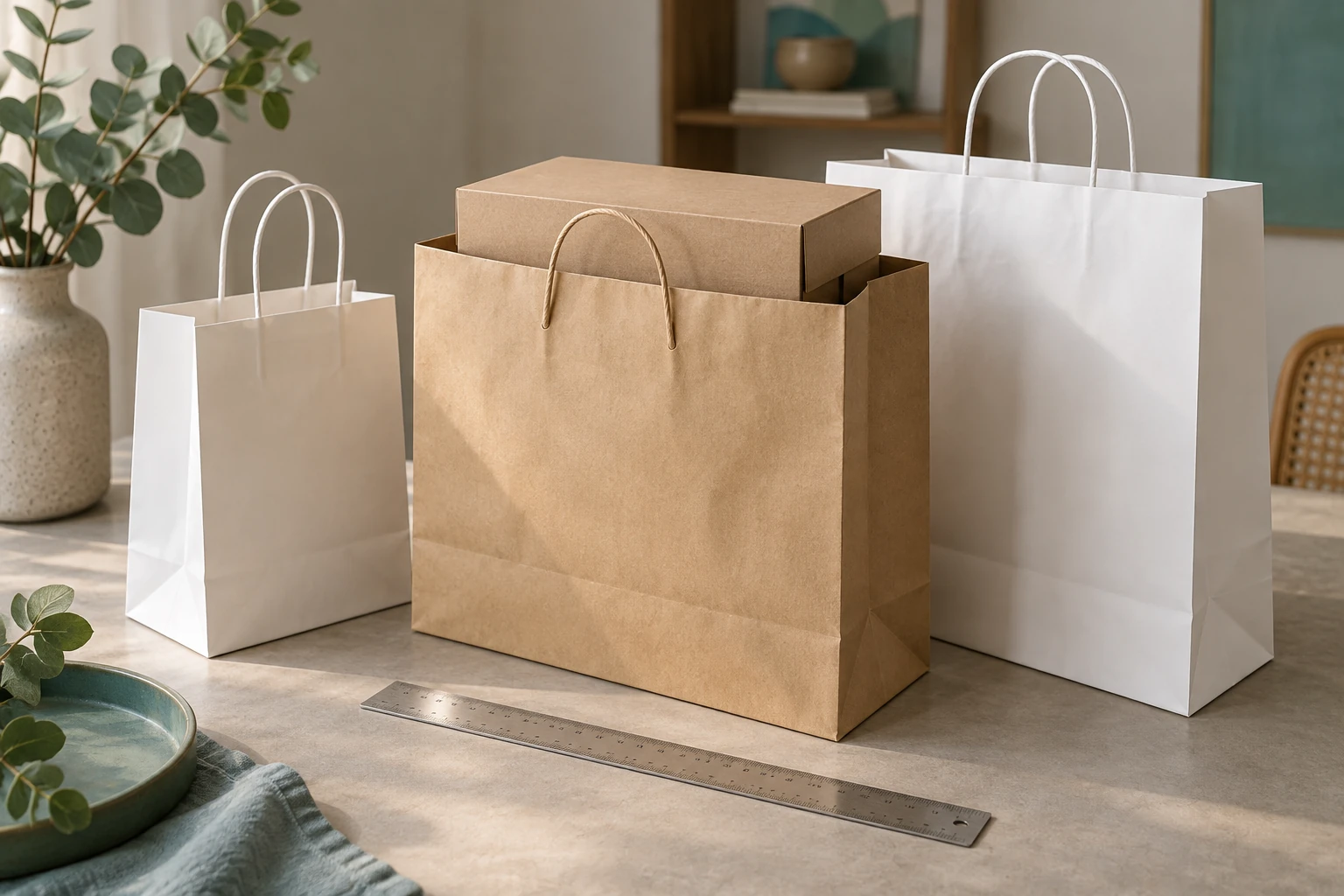
The size of the paper bag should be chosen from the complete set of packaged goods. If you only measure unpackaged products, businesses may miss boxes, lining paper or accompanying accessories. On the contrary, adding too much space makes the bag bulky and increases the amount of material used.
An effective way is to measure, make a sample and then try the operation at the counter. These three steps show whether the bag is suitable for both the product and the user.
Unify the way of recording dimensions
Shopping bags are often described by three numbers: width, waist, and height. Horizontal is the width of the main surface. The hip is the depth when the pocket opens. Height is the direction from the bottom to the top of the bag according to the agreed convention.
Recording order may vary between vendors. Therefore, you should clearly write each dimension and send captions. At the same time, confirm whether it is the outer size of the finished product or the internal measurement that can be used to store the goods.
Measure the outermost packaging
Place the product in a box or wrap it as it was given to the customer. Add the backing paper, protective sleeve, tags, and accessories actually included in the order, then measure the set.
If you often sell multiple items at once, create a typical order mix. Do not choose bag size based on a single product when most customers buy a whole set.
Leave space according to the operation
The bag needs clearance to put the box in, take the box out and avoid unnecessary friction. The appropriate amount of clearance depends on bag stiffness, product shape and packaging style, so there is not one plus number that will work for every order.
Example for testing: gift box with dimensions 24 × 10 × 18 cm, placed 24 cm horizontally, 10 cm deep and 18 cm high. You can make a sample bag of about 26 × 12 × 22 cm to start testing. This size is just a starting point to try. Production size needs to be confirmed after placing the actual box in the bag.
When testing, check that the folding mouth, reinforcement and strap position do not reduce ordering space. The size listed on the quote does not show all these details.
Choose bag size according to order group
| Order group | How to test | Things to pay attention to |
|---|---|---|
| A small dish | Place with box and card included | Is the product stuck? |
| A big box | Try putting the box through the top of the bag | Hips, bottoms and cleavage |
| Many dishes | Arrange as at actual sale | Stability and total mass |
| Gift set | Add enough lining paper and accessories | Height and presentation |
A store can start with a few bag sizes and then add more as usage data becomes available. It is necessary to consider the number of inventory codes and the proportion of orders that are properly packaged.
Check the ability to hold when in stock
Try holding the bag with the expected weight, observing the bottom and the strap attachment point. The length of the handle also affects how you can carry or place the bag on the table or hand it over at the counter.
If the product has sharp edges, a scratchy surface, or mass concentrated in one spot, an internal protective structure may be needed. Increasing bag size does not on its own solve these problems.
When should I adjust the size to save money?
A small change can affect the layout on the paper size or packaging, but the savings need to be calculated according to the actual configuration. Adjustments should only be made when the product is still conveniently placed and removed.
Send SquareBag the outer package size and product photo. If there are multiple sizes, add the common order group to exchange the appropriate bag size set.
Talk to SquareBagAll articles