SquareBag Packaging Industry Weekly | 16 November 2026
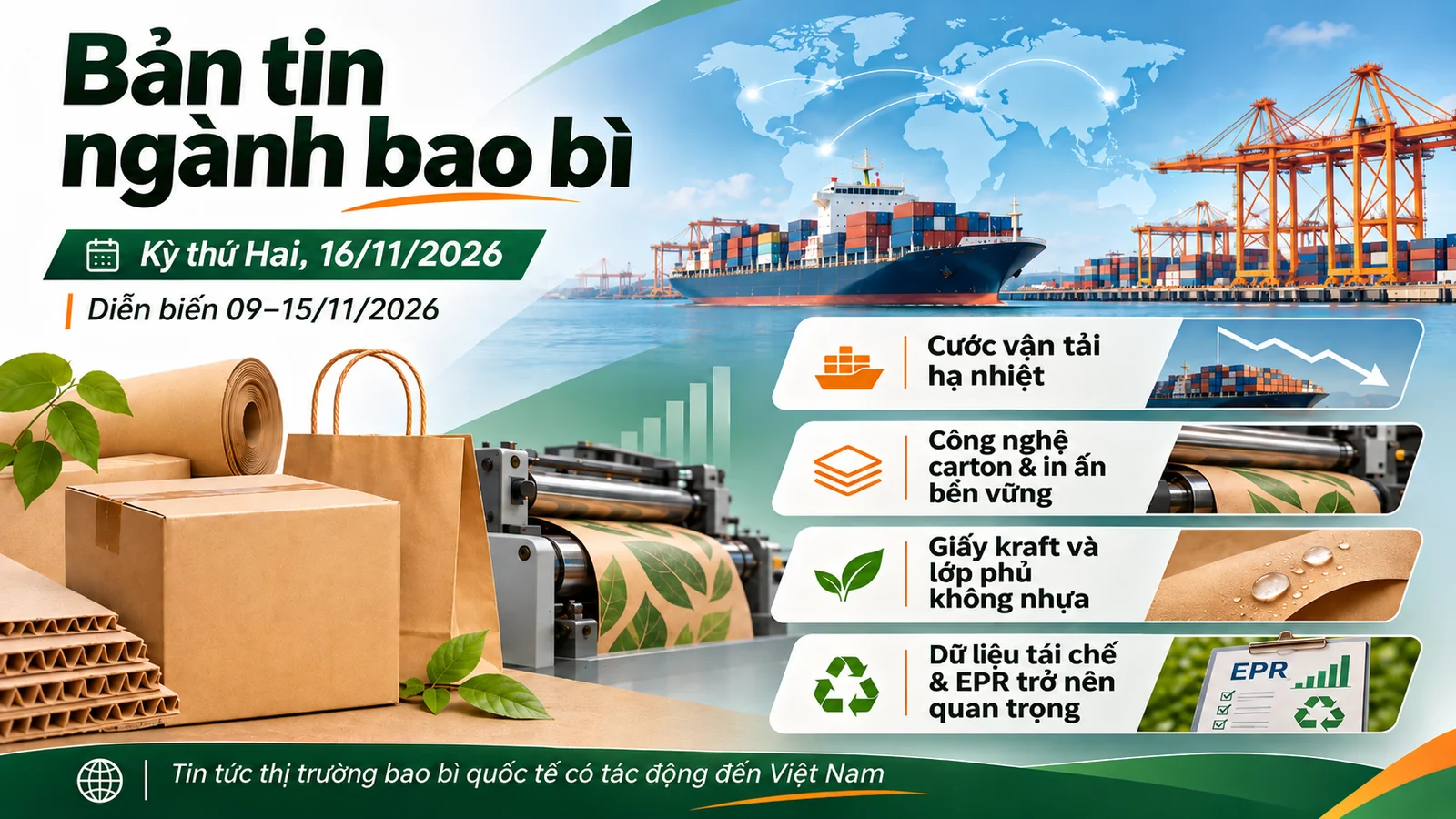
The global packaging industry saw several notable developments during 9–15 November 2026. Container freight rates declined across major international trade routes, while innovations in corrugated board production, paper-based packaging and sustainable printing attracted attention at the Sustainability Awards 2026.
At the same time, recycling transparency and Extended Producer Responsibility (EPR) requirements are creating new expectations for packaging manufacturers and international suppliers.
1. Container Freight Rates Decline Across Major Trade Routes
According to Freightos Baltic Index data reported on 10 November 2026, spot container freight rates declined across four major routes from Asia.
| Trade Route | USD per 40-ft Container |
|---|---|
| Asia – Northern Europe | 3,422 |
| Asia – Mediterranean | 4,324 |
| Asia – US West Coast | 8,245 |
| Asia – US East Coast | 9,708 |
The decreases reflect a moderation in shipping demand following the peak season and limited success in implementing planned early-November rate increases.
Implications for Vietnam: Lower benchmark rates may provide exporters with additional negotiating flexibility. However, actual shipping costs depend on departure ports, destination markets, carrier surcharges and vessel availability. Exporters should continue monitoring individual quotations rather than relying solely on international freight indices.
2. Cold Corrugation Technology Offers Potential Resource Savings
At the Sustainability Awards 2026, the Interpac 1250 cold corrugator and H.B. Fuller's Swift®tak PM 4400 adhesive technology received industry recognition.
Unlike conventional corrugated board production that relies heavily on steam and heat, cold corrugation offers an alternative manufacturing process designed to reduce resource consumption.
According to the performance figures presented for Interpac 1250, the technology has the potential to achieve:
98% lower water consumption.
60% lower CO₂ emissions.
Approximately 30% savings in corrugated board production costs.
Up to 80% lower transportation emissions in the proposed production model.
These figures represent reported technology performance and should not be interpreted as guaranteed savings for every manufacturing facility.
Implications for Vietnam: Cold corrugation could become relevant to small and medium-sized converters seeking flexible production and reduced dependence on externally supplied corrugated sheets. Investment decisions should nevertheless be based on verified throughput, product quality, adhesive costs and total operating expenditure.
3. High-Performance Kraft Paper and Plastic-Free Coatings Gain Recognition
Two paper-based packaging innovations were recognized at the Sustainability Awards 2026.
Mondi – Ad/Vantage Smooth Brown Semi Extensible
Mondi received the Renewables award for its high-performance kraft paper.
The 80 gsm material uses responsibly sourced, unbleached virgin wood fibres and is designed to offer mechanical strength, puncture resistance and compatibility with converting operations.
Its recyclability has been evaluated under the CEPI 4EG protocol for European paper recycling systems.
Xampla and Huhtamaki – Morro Plastic-Free Coating
Xampla and Huhtamaki received recognition in the Driving the Circular Economy category.
Their solution uses natural plant-derived polymers to provide a plastic-free coating for folded cartonboard packaging.
The technology is intended to maintain grease resistance and packaging integrity while supporting fibre recycling under suitable collection and processing conditions.
Implications for Vietnam: Paper bags, folding cartons and foodservice packaging manufacturers should assess emerging materials based on actual performance, regulatory requirements and recycling compatibility. Moisture protection, grease resistance, food-contact safety and cost remain essential considerations.
4. Acrylic-Free Flexographic Printing Ink Reduces Environmental Impact
Siegwerk received the Research & Development award for UniLEAF, its acrylic-free, water-based flexographic ink technology for paper and board applications.
UniLEAF replaces conventional acrylic resins with bio-based polymers.
Initial industrial trials demonstrated:
An additional carbon footprint reduction of approximately 50% compared with Siegwerk's UniNATURE formulation.
More than 15% lower drying energy consumption.
Potential annual energy savings of approximately 80 MWh per printing press under the reported industrial scenario.
Further validation is required across different printing systems and production conditions.
Implications for Vietnam: For paper packaging converters using flexographic printing, lower drying energy requirements could contribute to improved operating efficiency, provided technical performance and economic benefits are confirmed through production trials.
5. Recycling Data and EPR Compliance Become Strategic Priorities
On 11 November 2026, Systemiq and Earth Action launched the Packaging Data Hub, covering plastic packaging recycling data from 50 countries and 12 packaging formats.
Initial findings suggest that approximately 18% of plastic packaging is actually recycled across the countries covered. Flexible plastic packaging accounts for around 40% of plastic packaging waste but achieves an actual recycling rate of only approximately 10%.
During the same week, Specright and Lorax EPI highlighted digital tools designed to standardize packaging specifications and support EPR compliance.
Implications for Vietnam: Packaging suppliers serving international customers should strengthen their ability to document material composition, product weight, recycled content, certifications and relevant environmental characteristics.
Maintaining consistent specification records for each stock-keeping unit (SKU) can improve quotation accuracy, traceability and regulatory readiness.
6. Outlook for Vietnam's Packaging Industry
The week's developments highlight three industry priorities: cost control, material innovation and supply-chain transparency.
For SquareBag and other Vietnamese packaging businesses, practical opportunities include evaluating alternative paper materials, testing resource-efficient manufacturing technologies and improving product specification management.
Nevertheless, the available evidence does not yet establish a sustained decline in domestic paper prices or a broad recovery in Vietnamese packaging demand.
Three Developments to Watch: 16–22 November 2026
Freight and logistics costs: Further adjustments in Asia–Europe and trans-Pacific shipping rates.
Paper prices and alternative materials: Trends in kraft paper, recycled paperboard and plastic-free barrier technologies.
Technology and compliance: Commercial adoption of cold corrugation, energy-efficient flexographic inks and evolving EPR data requirements.
Conclusion
The packaging industry's transition is increasingly defined by more than material cost alone. Resource-efficient production, responsible material selection and reliable environmental data are becoming important elements of competitiveness.
SquareBag will continue monitoring these developments to support practical, innovative and sustainable paper packaging and printing solutions for its customers.
SquareBag Packaging Market Review | Reporting period: 9–15 November 2026.
Sources: Freightos / CommoPlast, Packaging Europe, Siegwerk, Packaging Data Hub.